Lino printing (or lino cutting) is a 'block' printing technique and is considered to be one of the simplest forms of printing. The process, like any other, begins with the choice of a design. A mirror image of the chosen design is them produced onto the lino block either through tracing the original image or sketching it freehand. The areas of the design which aren't to be physically printed are then carved from the block and once this is finished the block is inked with a roller and printed onto your material base of choice (this is usually done manually but a printing press can also be used).
Examples of lino prints:

Mono printing:
Mono printing is appraised as a very versatile form of printing as it allows the artist to work positively or negatively, with water-based or oil based inks, and even gives the opportunity to mix materials. In order to create a monoprint/monotype you will require a plate of any type (so long as it is non-porous) and ink. A variety of tools can be used to paint your plate (such as paintbrushes, sponges, your fingers, and even sharp objects such as needles of scissors) which will create a wide range of effects. Once your image is painted, the printing process is completed by placing the plate onto a press bed and carefully placing your dampened material of choice over the top of it, running it through the press and applying pressure to produce your print.
Examples of mono prints:
 |
| "Abuela" |
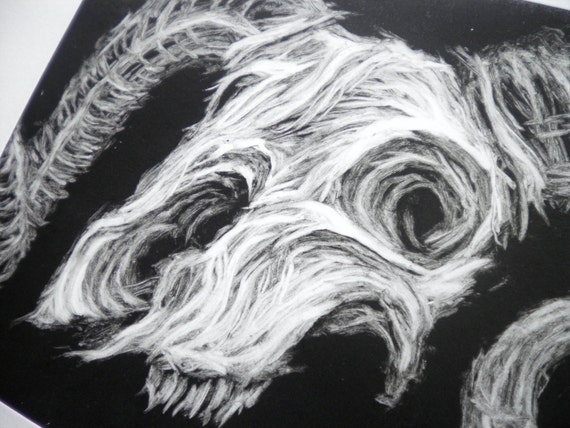 |
| "Rams Skull" |
Lithography:
Lithography is used heavily for commercial print as it can mass print copies of the same design in one production run. Lithography machines rely on four basic colours, cyan, magenta, yellow and black, and can print on both sides of any paper/card. The process involves a printing plate which has the image to be printed on its surface. This plate is kept dampened and ink is placed onto it. The printing cylinder then rotates and transfers the ink onto the rubber blanket cylinder, which is then pressed onto the base material (paper or card) and pulled through the machine.
Lithography is used heavily for commercial print as it can mass print copies of the same design in one production run. Lithography machines rely on four basic colours, cyan, magenta, yellow and black, and can print on both sides of any paper/card. The process involves a printing plate which has the image to be printed on its surface. This plate is kept dampened and ink is placed onto it. The printing cylinder then rotates and transfers the ink onto the rubber blanket cylinder, which is then pressed onto the base material (paper or card) and pulled through the machine.
Examples of lithography:
 |
| "Storm" |
Risograph printing:
Risograph printing is basically a printing machine which is borderline between photocopying and screen printing. It can be used to print multi-coloured designs, however, like screen printing, it can only print one singular colour at a time. The risograph machine works by printing your image directly from a computer or from the scanning table located on the top of the machine (hence why it's similar to a photocopier). The image gets transfixed onto a 'master sheet' which wraps around a colour drum in the center of the machine, and a 'master copy' acts as a screen for which the ink is pressed through and onto the paper - creating your print. The paper is sent through the printer multiple times if the design incorporates more than one colour.
Examples of risograph printing:
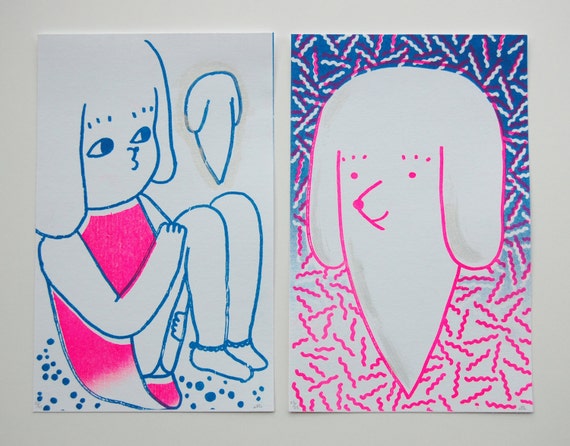 |
| "The Apparition of Ghost Dog" |
 |
| Viktor Hachmang |
Woodblock:
Woodblock printing requires very few tools and the piece of wood used can vary in size, making it convenient to do in work spaces such as your own home. There are typically two ways in which you can relief print with wood - "woodcut" and "woodblock". Woodcut involves cutting along the grain of the wood, incorporating the texture of the wood into your final print, whereas woodblock uses a more compact grained wood which allows you to carve designs more freely. The process of woodblock printing begins with sketching the design onto you block, which is then carved into and then inked with a roller (a lot like lino printing). Once inked the design can be printed onto your base material.
Examples of woodblock:
Examples of woodblock:
 |
| "Window" |
 |
| Ichijô Narumi |
Sources used:
Websites:
Websites:
- http://www.howtolinoprint.com/
- http://www.monoprints.com/about_monoprints.php
- http://www.technologystudent.com/designpro/prtpro5.htm
- http://www.peowstudio.com/print/
- http://www.instructables.com/id/Creating-cutting-and-printing-your-own-woodblock/?ALLSTEPS

No comments:
Post a Comment