Screen printed designs:
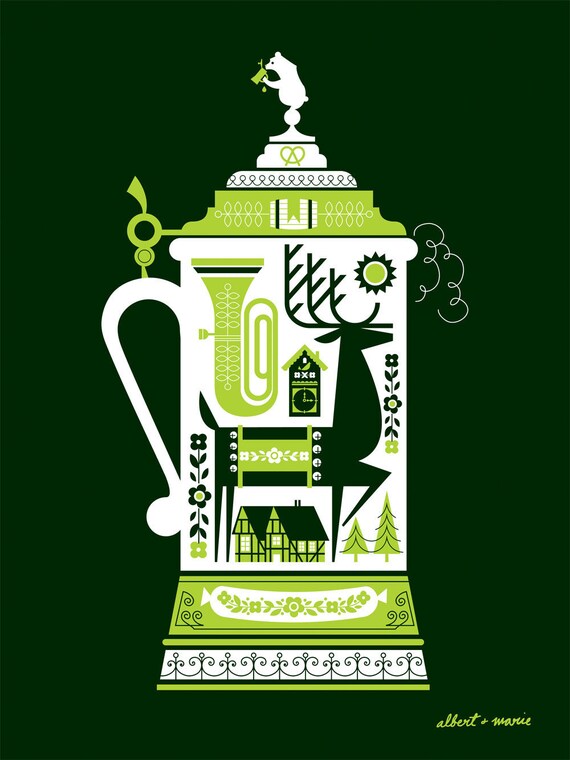 |
| "DeerStein" |
 |
| "Bernie's Burger Bus Ketchup" |
The advantage of screen printing over other forms of printing is that the press can print on substrates of any shape, thickness and size. A significant aspect to this process is the amount of excess ink which can be applied to the base material, which exceeds the general amount able to be applied with any other printing process. This allows the creation of some interesting effects, and because of the simplicity behind this particular process a wider range of inks and dyes can be used.
Screen printing consists of three elements: the screen, the squeegee, and the ink. A porous mesh is stretched tightly over a wooden or metal frame and a stencil is produced onto this 'screen' either manually or photo-chemically. Once the stencil is produced it's placed over the chosen material base and, depending on the effect desired, a certain thickness of ink is layered over the screen. The ink is then forced through the open areas of the screen (where no stencil is applied) by applying pressure with the squeegee and the image is formed on the base material beneath the screen. Many factors play a role in the quality of the screen print produced, such as the composition, size, angle and even the speed at which the squeegee is drawn across the screen.
An average price for a 1 colour print on a 100% cotton t-shirt ranges from £3 to £5. However, the price can rise considerably if additional colours are added to the design (Each colour requires a separate screen).
Companies which specialize in screen printing:
Sources used:
Websites:

No comments:
Post a Comment