Friday, 17 April 2015

Business Cards

Business cards are an effective and compact way to sell yourself to potential clients, provided you design them right. They have the capability to sell your design business all on its own and thus are an essential factor whilst networking and attempting to get yourself out there.

Aspects which you should focus on whilst designing a business card include:


  • The concept - You need to openly inform the potential client of the nature of your business. Including your logo and aspects from your web design displays a tenacious link and creates the sense of a set style, making it a reassuring factor. Taking advantage of both sides of your card is also recommended.
  • The content - Your name, title, company and contact information should be clearly displayed on the card. This not only shows your consideration for the design of the actual card but it also ensures potential clients CAN contact you directly without having to physically search for you via internet or social media - an off-putting aspect. 
  • The font - As a creative business it is imperative that you harness your knowledge of typography and choose an appropriate font. Choose something which reflects the nature of your company while maintaining an overall professional look and remaining clear to read. 
  • The colour - Sticking to CMYK will ensure your business card will look as anticipated, meaning no surprises during the print process. Cards with a colour scheme are also 10 times more likely to be kept over standard, plain business cards.
  • The material - Many materials are now readily available to enhance creativity when producing a piece of work. This means you have the potential of using different materials which enhance and reflect the feel of your company, making it more memorable/appealing and more likely to be hung onto. 
Presenting your card properly is also a crucial factor whilst meeting new people as it not only leaves an impression of you but your company. The argued etiquette for handing out a business card is to politely hand it to them with a clear notion of what you are doing, do not slide the card between your fingers and pass it to them or shake hands whilst the card is in your hand - this ensures that your card remains intact and still looks presentable upon handing it over.

Examples of effective business cards:
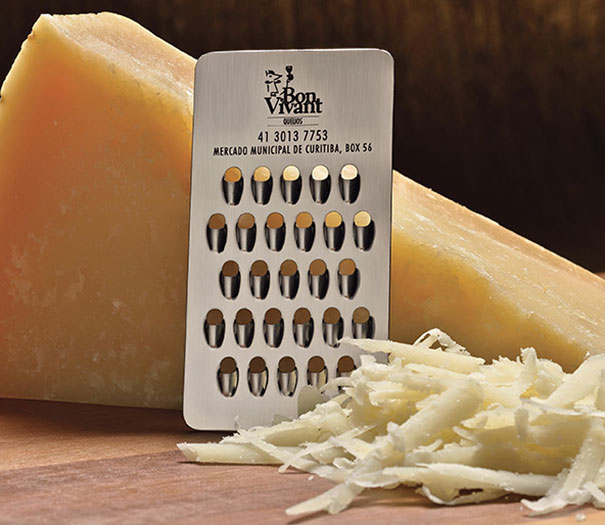
Cheese grater business card.
Advertising agency: JWT, Brazil.

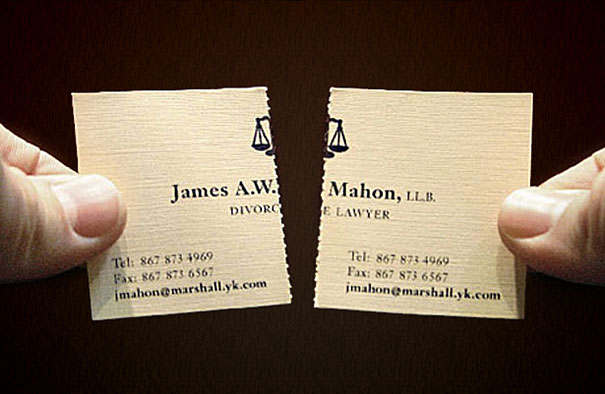
Tearable divorce lawyer business card.


Dentist's cavity business card.
Designed by: Michael Hane and Remo Caminada.

Makeup business card.
Advertising agency: OpusMultipla, Curitiba, Brazil.


Sources used:

Websites:

Thursday, 16 April 2015

Creative Industries - What's happening now?

The UK as a whole currently holds the second biggest design sector in the world, gaining approx £36 billion a year from creative industries such as art, film, music and media - 8% of the UK's GDP coming from these sources. The country's capital, London, was also dubbed the most influential city amongst the creative industry by Forbes magazine, and the country in its entirety is regarded for its influences world wide - even working collaboratively with other countries. Our creative graduates also benefit from our renowned creative industry status and are often exported world wide to move on to bigger and better things within the design industry, an exciting and motivating aspect.

As an aspiring graphic designer myself it is key for me to acknowledge what is happening now within the creative industry. Current trends and popular artists include information which designers should always be kept up to speed on in order to produce quality work which fits into the contemporary standards and gains the interest of the general public.

Some general topics which designers need to know include the seasons colour, top selling contemporary artists, Oscar awards for the likes of best animation, popular artists within the music industry, who won what festival and even food fashion trends. All of these aspects help keep an artist with the times and ensure that their work fits recent standards set by said 'trends'.

The website NOWNESS is a good way to keep up with contemporary culture via film. They release new films each and everyday which "gets under the skin of the most influential names across art and design, fashion and beauty, music, culture and food and travel."

Newcastle.

Newcastle is surprisingly regarded as a creative city which is located just on the banks of the River Tyne in the Tyne & Wear, and with the overall decline of industries such as the wool trade, coal mining and ship building, it has made way for a much more innovative approach to the design industry.

"... Newcastle's economy is thriving with learning, digital technology, retail, tourism and culture all playing a part in its success. What's more, the creative industries are rapidly growing here and the city has plenty to offer the discerning freelance profession who's looking for somewhere to live, work and play."

It is even said to offer some of the best places to set up a secure establishment for design based careers outside of London, allowing some great opportunities for aspiring designers who are more locally based. The thriving atmosphere of this so called creative city also grant access to potential networking, an essential aspect for any designer (new or experienced) and in 2014 it hosted the 'Newcastle Arts Festival'.

It also has its fair share of art museums and exhibitions, including:
  • The Laing Art Gallery, which features paintings from 18th-20th century.
  • The Biscuit Factory, an expansive art, craft and design gallery which I actually paid visit to during a trip in college. It proved to be both inspirational and motivational, one of the most memorable pieces displaying a fair amount of decor flamingos.
  • BALTIC Center for Contemporary Art, a major international gallery and events hub.
And finally, Newcastle even offers unique spaces in which you can work, including Hoults Yard, a friendly office and studio complex which hosts events such as 'Warehouse parties', live music, barbeques, and art exhibitions - making it great for networking too, and the Toffee Factory, a refurbished building which provides both contemporary and high quality office space for digital and creative businesses alike, claimed to be "an inspiring and stunning place to work."


Sources used:

Websites:


  1. https://www.nowness.com/about
  2. http://www.creativeboom.co.uk/travel/creative-cities-newcastle-upon-tyne/
  3. http://www.newcastlefestival.org/
  4. http://www.twmuseums.org.uk/laing-art-gallery.html
  5. http://www.thebiscuitfactory.com/
  6. https://www.balticmill.com/
  7. http://www.houltsyard.co.uk/about/
  8. http://www.toffeefactory.co.uk/

The Truth Is Out There - After Graduation

What area of my discipline do I wish to pursue?

When I first became interested in working creatively for a living I was adamant I would become a freelancer and work happily for myself (see "Where do I see myself" research). However, after completing further research I have become quite daunted by the concept of working alone and have began to carefully consider my options. In my first year at uni I have already tackled an array of tasks including typography, logo design, and even book making, all of which I feel are opening up artistic opportunities for myself, but none of which have truly helped me decide on a particular discipline. I'm still learning and thus still considering which area exactly I desire to pursue.

What transferable skills can I gain from my degree?

In my first year at uni I feel that I have already acquired a vast amount of skills and knowledge which will later help me in an artistic career. These skills include the design of signs, symbols, and logos, typography, posters and books (including their layout) and even animation. I have also gained knowledge of several different softwares (Illustrator, InDesign, Birdfont) and social skills in my attempts to contact both fellow artists and clients. As this is only my first year I can only imagine the abundance of transferable skills I have yet to learn and apply in a future career.

What post graduate courses could I apply for after graduating?

If I so desired I could apply for a post graduate course upon my completion of my course at uni and go on to earn a Masters Degree or even a PhD. Upon researching post graduate courses I could later attend I found a "Communication Design: Graphic Design MA" course based at Kingston University in London.

"This course encourages the exploration and understanding of the methods and processes at work in contemporary visual communication, and will further develop your personal practice and approach to graphic design. It focuses on individual research and enquiry and helps you to develop your understanding of the significance of the wider cultural role of the visual designer. In addition, you will be introduced to disciplinary and interdisciplinary models of thinking that will underpin your own focused study on the course."

The course would even allow me to learn another language. Despite being both interesting and appealing I am unsure as to whether further education after uni is for me. Although I feel this course would be undeniably beneficial I am already benefiting highly from my current course and believe that it may be better to seek employment over further education.

Sources used:

Websites:

http://www.kingston.ac.uk/postgraduate-course/communication-design-graphic-design-ma/

Wednesday, 15 April 2015

Copyright

What is Copyright?

From google definition the term copyright relates to the "exclusive and assignable legal right, given to the originator fro a fixed number of years, to print, publish, perform, film or record literary, artistic or musical material."

The copyright law was was first authorized by Charles II in 1662, during the time of the printing press when the production of books and newspapers allowed them to be easily reproduced/copied. This law prevents any form of original content from being taken and reproduced under the name of anyone who is not the original creator, thus making it incredibly important for everyone in the artistic industry. The law itself is an automatic right, meaning you don't have to physically do anything to ensure your work is copyright protected - the moment you produce any original content (keep in mind this applies only to physical work and not merely ideas) it is yours and yours alone. This particular law not only applies to the artists during their lifetime, either, but also 70 years after their death. A very reassuring factor for any kind of content creator, but one which is often up for debate.

Elements which Copyright protects your work against:

  • The copying of work
  • Distribution of work (free or otherwise)
  • Making an adaption of an original piece
  • Displaying of work on public premises or on the internet 
There have been many cases of Copyright throughout time and some cases involve the well known brand of Primark, which has ironically become well known for its complete disregard of copyright laws - often causing insult with poorly recreated catwalk designs and plagiarized prints.

The company known as Whittards also recently claimed the rights to the well known Alice in Wonderland illustrations by John Tenniel upon the surpassing of the 70th anniversary of his passing. These illustrations have now been reproduced in Whittards name and it's these particular acts which often stir debates and arguments amongst creative producers (as mentioned previously)

Music is also another artistic aspect which is struck with countless copyright laws and the list of artists accused is both long and shocking. One of the most recent cases involving Robin Thicke and Marvin Gaye, other candidates including One Direction, David Bowie and Vanilla Ice.

Tuesday, 20 January 2015

Exhibitons

What are exhibitions?
The word "exhibition" originates from the Latin/late Latin words "exhibere" ('hold out') and "exhibitio" and refers to the public display of artwork or items of interest - most typically held in art galleries of museums. Exhibitions may also be referred to the likes of 'shows', 'presentations', 'demonstrations' or 'spectacles'. The word can also mean "a display or demonstration of a skill" hence why artists most commonly partake in them - to showcase themselves and their abilities.

Exhibitions typically follow a particular theme in which the artist will base their work around, allowing them to publicly display their personal art style and attract both potential clients and buyers. This makes exhibitions an incredibly important part of the design industry structure as it builds up reputation and gets you otherwise acknowledged by a large variety of the public - creating openings for opportunities.

The essentials of exhibitions:
  • Target and know your market effectively
  • Set expectations
  • Price your costs accordingly to these expectations
  • Design the show/exhibition
  • Promote the exhibition
  • Invite guests for private viewings
  • Consider the package as a whole


Permanent galleries:

  • House of Illustration - A registered charity which "is the home for the art of illustration". Opened their doors in the summer of 2014 and displays work by both emerging artists and those already established.
  • The Illustration Cupboard - A unique art gallery located in central London which recognizes contemporary book illustrators from around the globe. Has organized events such as artist's exhibitions, themed events and even national festivals since 1995.
  • Beach London - A gallery/creative agency which works with a broad range of commercial creatives. They partake in a productive range of projects, exhibitions and events and have also been known to combine the three. Clients include the likes of ASOS, Topman and MTV.
  • Kemistry - An independent design gallery founded in 2004. It is dedicated to exhibiting the work of past, present and upcoming designers and aims to make design available to audiences who may overlook/undervalue it's importance when compared to fine art and photography.

National Exhibitions:
  • Serco Prize - Based in London's Transport Museum and invites illustrators to create pieces of work which revolve around the theme of London. The theme for 2015 is "London Places and Spaces" and the aim of the competition is to bring forth artwork which is colourful and inspiring for display.
  • Grafik Magazine - "A home for the world's most inspiring graphic design". Based in a London office, they "report on the latest projects by both upcoming and established design talent around the world, explore graphic design history, represent the ideas of design practitioners, and provide a forum for thinking and writing about graphic design".
Outdoor Indoor Walls:
  • Hoults Yard - An office and studio complex situated in Newcastle with a modern but vibrant twist. Holds events such as 'Warehouse parties', live music, barbeques, and art exhibitions. 
  • Artist Hotel Brighton - Located in the historic Regency Square, this eccentric hotel holds twenty three rooms each filled with individual artwork. It offers a sea view of the West Pier, a chilled out atmosphere, and some general "down to earth hospitality" in which you can relax and enjoy the "reclaimed vintage style".

Festivals:
  • Pick Me Up - Onto its 6th festival, Pick Me Up is the UK's original graphic arts festival which focuses on the likes of contemporary graphic art, design and illustration.
  • London Illustration Fair - Established in 2013 it's "London's freshest artist-led illustration, print and design fair" and allows emerging talent to be brought into the lime-light by displaying it in an environment filled with illustration lovers.
  • Illustrative Berlin - Has become a worldwide renowned art festival since it's beginning in 2006 and is known as the "leading international festival for contemporary illustration and graphic arts". The whole concept behind this festival is to display the entirety of international illustration and graphic art in one singular exhibition.
  • Design Event - Established in 2005, it both supports and promotes designers across the Northern region (especially graduates and those less established) and provides regional/national platforms to showcase design work of a high quality. 
  • London Design Festival - An annual event which was first held in 2003. It's composed of over three hundred and fifty events/exhibitions and is held in order to promote the idea that London is the design capital of the world. {Watch a video on it here}

Case Studies:
  • Stefan Sagmeister | The Happy Show - This particular installation covers the entire second-floor (and ramp) of the Institute of Contemporary Art, offering "visitors the experience of walking into Stefan Sagmeister's mind as he attempts to increase his happiness via mediation, cognitive therapy, and mood-altering pharmaceuticals".
  • Tove Jannsson | Ateneum Art Museum - As a celebration of the 100th anniversary since Jannsson's birth, the Ateneum showcased decades worth of work from her "impressive career as an artist, illustrator, political caricaturist, author, and creator of the Moomin characters and stories". The exhibition covered all the periods of her productive career and included loaned pieces of work from Finnish museums.
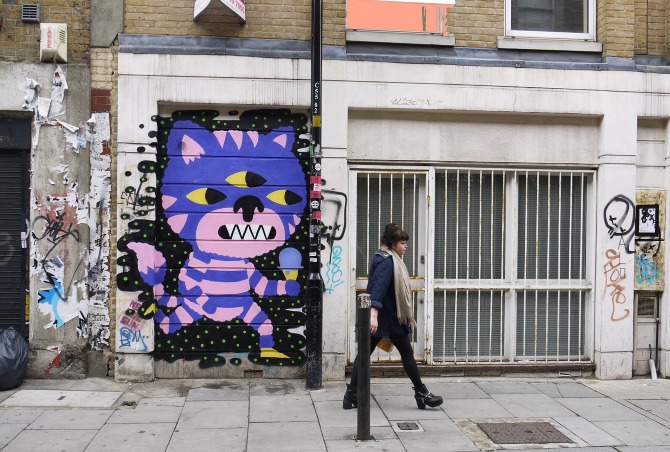
  • Malarky - A street painter and illustrator known for sprucing up the grey and drab London streets with vivid and colourful works of art, using buildings, trucks and many other raw street materials as a canvas.


Sources used:

Websites:
  1. https://www.houseofillustration.org.uk/about/who-we-are
  2. http://www.illustrationcupboard.com/aboutgallery.aspx
  3. http://beach.london/about
  4. http://kemistrygallery.co.uk/about/
  5. http://www.theaoi.com/events/
  6. https://www.facebook.com/grafikmagazine/info?tab=page_info
  7. http://www.houltsyard.co.uk/about/
  8. http://artistresidencebrighton.co.uk/about-us/
  9. http://pickmeuplondon.com/index/about/
  10. http://www.thelondonillustrationfair.co.uk/about-us/
  11. http://www.illustrative.de/festival/about/
  12. http://www.design-event.co.uk/AboutUs.php
  13. http://www.londondesignfestival.com/about
  14. http://www.sagmeisterwalsh.com/work/project/the-happy-show/
  15. http://www.ateneum.fi/en/tove-jansson
  16. http://www.malarko.com/ABOUT


Thursday, 18 December 2014

Frances Moffatt

Frances Moffatt is both an author and a freelance fashion illustrator based in the North East, and after achieving a BA Hons in fashion marketing she admirably built up her reputation through use of promotional packaging and the creation of her own personal website. This not only secured her work with companies such as Lullaby and Go Girl magazine, but also got her acknowledged by Bright Agency. One of her most successful and recognized pieces is an illustrative exercise book titled "The Fashion Exercise Book" which she worked on with a company named Batsford. This book has been featured in stores such as Waterstones and TK Maxx, and has even been displayed in galleries such as the Tate and the Baltic.


With regards to her style, it appears to follow the typical 'fashion illustrator' vibe. Her use of line suggests the detail and depth within the image, and a splash of colour or a specific pattern is used to further enhance her pieces. Despite using no tone or shadow, she still maintains a sense of realism within her designs and overall has a very has a very sophisticated style of illustration.

The Pitch - Other Printing Techniques

Lino Printing:

Lino printing (or lino cutting) is a 'block' printing technique and is considered to be one of the simplest forms of printing. The process, like any other, begins with the choice of a design. A mirror image of the chosen design is them produced onto the lino block either through tracing the original image or sketching it freehand. The areas of the design which aren't to be physically printed are then carved from the block and once this is finished the block is inked with a roller and printed onto your material base of choice (this is usually done manually but a printing press can also be used).

Examples of lino prints:
Mono printing:

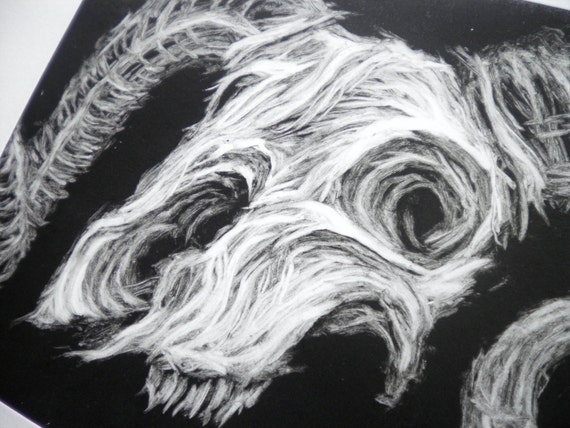
Mono printing is appraised as a very versatile form of printing as it allows the artist to work positively or negatively, with water-based or oil based inks, and even gives the opportunity to mix materials. In order to create a monoprint/monotype you will require a plate of any type (so long as it is non-porous) and ink. A variety of tools can be used to paint your plate (such as paintbrushes, sponges, your fingers, and even sharp objects such as needles of scissors) which will create a wide range of effects. Once your image is painted, the printing process is completed by placing the plate onto a press bed and carefully placing your dampened material of choice over the top of it, running it through the press and applying pressure to produce your print.

Examples of mono prints:

"Abuela"

"Rams Skull"
Lithography:

Lithography is used heavily for commercial print as it can mass print copies of the same design in one production run. Lithography machines rely on four basic colours, cyan, magenta, yellow and black, and can print on both sides of any paper/card. The process involves a printing plate which has the image to be printed on its surface. This plate is kept dampened and ink is placed onto it. The printing cylinder then rotates and transfers the ink onto the rubber blanket cylinder, which is then pressed onto the base material (paper or card) and pulled through the machine. 

Examples of lithography:

"Storm"
Risograph printing:

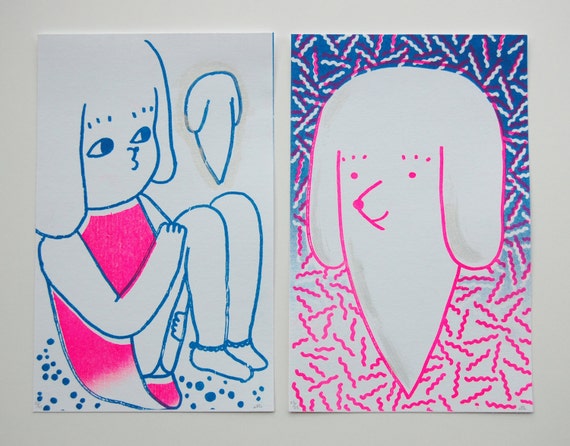
Risograph printing is basically a printing machine which is borderline between photocopying and screen printing. It can be used to print multi-coloured designs, however, like screen printing, it can only print one singular colour at a time. The risograph machine works by printing your image directly from a computer or from the scanning table located on the top of the machine (hence why it's similar to a photocopier). The image gets transfixed onto a 'master sheet' which wraps around a colour drum in the center of the machine, and a 'master copy' acts as a screen for which the ink is pressed through and onto the paper - creating your print. The paper is sent through the printer multiple times if the design incorporates more than one colour.

Examples of risograph printing:

 
"The Apparition of Ghost Dog"
Viktor Hachmang
Woodblock:

Woodblock printing requires very few tools and the piece of wood used can vary in size, making it convenient to do in work spaces such as your own home. There are typically two ways in which you can relief print with wood - "woodcut" and "woodblock". Woodcut involves cutting along the grain of the wood, incorporating the texture of the wood into your final print, whereas woodblock uses a more compact grained wood which allows you to carve designs more freely. The process of woodblock printing begins with sketching the design onto you block, which is then carved into and then inked with a roller (a lot like lino printing). Once inked the design can be printed onto your base material.

Examples of woodblock:

"Window"
Ichijô Narumi

Sources used:
Websites:
  1. http://www.howtolinoprint.com/
  2. http://www.monoprints.com/about_monoprints.php
  3. http://www.technologystudent.com/designpro/prtpro5.htm
  4. http://www.peowstudio.com/print/
  5. http://www.instructables.com/id/Creating-cutting-and-printing-your-own-woodblock/?ALLSTEPS


Wednesday, 17 December 2014

The Pitch - Screen printing

Screen printing is an incredibly versatile form of printing as it can be used to print on a wide range of materials such as paper, paperboard, plastics, glass, metals, and fabrics including nylon and cotton. Commonly seen products produced through screen printing include the likes of posters, labels, decals, signage and all types of textiles.

Screen printed designs:

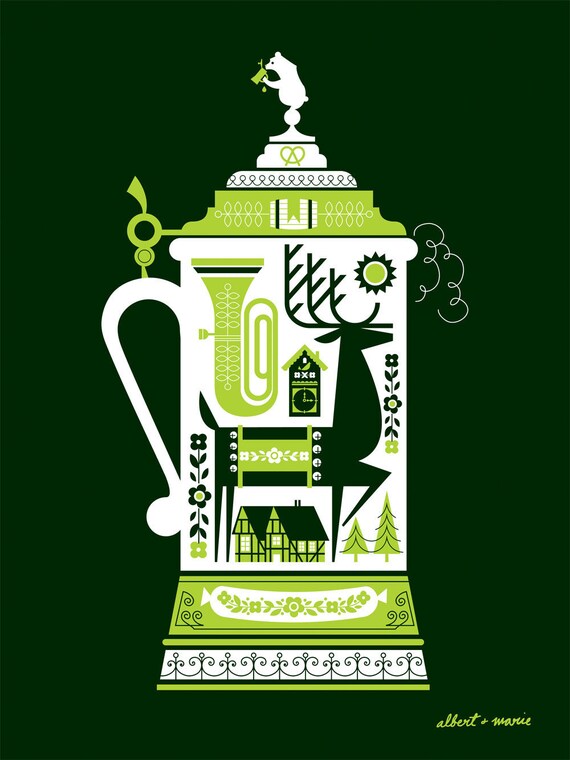
"DeerStein"
"Bernie's Burger Bus Ketchup"
The advantage of screen printing over other forms of printing is that the press can print on substrates of any shape, thickness and size. A significant aspect to this process is the amount of excess ink which can be applied to the base material, which exceeds the general amount able to be applied with any other printing process. This allows the creation of some interesting effects, and because of the simplicity behind this particular process a wider range of inks and dyes can be used.

Screen printing consists of three elements: the screen, the squeegee, and the ink. A porous mesh is stretched tightly over a wooden or metal frame and a stencil is produced onto this 'screen' either manually or photo-chemically. Once the stencil is produced it's placed over the chosen material base and, depending on the effect desired, a certain thickness of ink is layered over the screen. The ink is then forced through the open areas of the screen (where no stencil is applied) by applying pressure with the squeegee and the image is formed on the base material beneath the screen. Many factors play a role in the quality of the screen print produced, such as the composition, size, angle and even the speed at which the squeegee is drawn across the screen.

An average price for a 1 colour print on a 100% cotton t-shirt ranges from £3 to £5. However, the price can rise considerably if additional colours are added to the design (Each colour requires a separate screen).

Companies which specialize in screen printing:
{ PEOPLE OF PRINT: "20 screen print artists you should all know about" }


Sources used:

Websites:
  1. http://pneac.org/printprocesses/screen/

The Consumer

The term "consumer" relates to a person who purchases items and/or services for their personal use. They may also be referred to as customers, clients, or even just 'the public'. "Consumers" are the people at the end of the production line - the main focus during the creation of any product. As a graphics design student interested specifically in the advertisement aspect of design, my job will involve catering to many, if not all, of the general public. I will have to create designs which will appeal to a large variety of demographics, and these designs will be essential to selling products.

Who are you?

As I consumer I don't necessarily have a 'set' style when it comes to purchases, and I prefer more-so to take different elements from specific styles and mesh them together - allowing me to create my own distinct 'style'. This creates the opportunity for me to purchase a larger range of things and to have a more personal taste.

What do you buy?

My most typical buys involve books and clothes. When it comes to books I definitely judge by it's cover. I like covers with intricate designs, the kind that not only look pretty but also seem to allude to the story - especially if it's in a confusing way. The more questions I need ask, the more likely I am to buy. With regards to clothes I always find that I'm torn between a mixture of styles, but I tend to go with a more vintage style, taking an "old is new" approach to what I wear. Overall I think I definitely have a tendency to go for things which appear timely or unusual, but remain aesthetically pleasing as this makes them appear quirky, and I'm always on the look out for how past styles can influence the more contemporary styles of today.

What demographic are you?

Although I do go for more timely designs, I believe I still stand in the "young adult" category as a consumer. This is mostly due to the fact that when I gain inspiration for a new outfit, or purchase a new product in general, my main influences come from seeing people my age with said product.

How are you targeted?

I think I'm targeted through several different means. Firstly, there's the generic advertisements you see everywhere in day to day life, whether it's on tv, in a magazine, or on the radio. I also find that my attention is regularly captured by window displays at the front of shops, which are catered to a wide range of the general public, and once I've spotted something I almost always end up going inside for a better look. Mostly, though, I feel that I am targeted via social media. I spend a lot of time on my phone and am thus a heavy user of apps such as Instagram and Pinterest, both of which I use for inspiration with regards to many different things (clothes, artwork, recipes), and even Facebook, which displays advertisements catered to what I've ran through google search - making the products advertised more personal and appealing to my individual taste.


What sets you apart from the general public?

My personal taste, just like anybody else's would set them apart from me. As a mass we can like the same, generic things, but personal taste is what makes us all differ. Each and every member of the general public will have a refined personal taste, for example two different people may like the style of a certain blouse, but one may prefer the floral pattern whereas the other's preference lies with the plain one. Each liked the general style of the blouse, but personal taste allowed them to be set apart from each other.

Sean Sims

Sean Sims is an illustrator/graphic design artist based in Brighton but originally from Teeside. After previously attending Cleveland College of Art and Design, Sims went on to gain clients such as the BBC, The Guardian, The Sunday Times, Virgin and Vodafone.

One of this most successful pieces is his own personal take on the London underground map, titled: "The Brighton Line".

He is, however, also know for his colourful, child-like illustrations which are both fun and quirky:


He typically works in a program called Illustrator and his playful designs are composed of both basic shapes and basic colours, despite this simplicity though they still remain detailed and have a sense of fun surrounding them. The simplicity behind his designs also allows them to be used in a wide variety of different products, and it has in fact secured him work within different parts of the design industry - such as publishing and even greetings cards.

Sources used:

Websites:
  1. http://www.artrepublic.com/biographies/265-sean-sims.html
  2. http://www.artrepublic.com/artists/780-sean-sims.html
  3. http://seansimsillustration.blogspot.co.uk/


Tuesday, 16 December 2014

Publishing

Publishing, or to publish, is the occupation of preparing/issuing material (such as books and journals) for sale. The word originated from the Latin words "publicus"/"publicare" ('make public') which later became "puplier" in old French, until eventually becoming "publish" in middle English, meaning 'make generally known'.

In the UK there are approximately 150,000 people employed within the publishing industry and it has a number of different areas which you can work in, such as book publishing, computer game publishing, journals, zines, magazine or newspaper publishing, and even software publishing. Different stages of the publishing process include creation and design, distribution and retail, and production.

The book publishing industry in particular is popular for graphic designers and illustrators alike as the art of book covers is often what gets the book itself noticed, not only making it incredibly important to the author but also giving a great window of opportunity for you to have your work noticed by the general public.
Designing a book cover is no east task, however, as it requires a number of different things. Firstly, you would have to commit to a very close reading of the book itself. This allows you to understand what you're designing, and in acknowledging the smaller details of the product gives easier inspiration for obscurities you could relate your design to. Collaboration with the author is also essential, after all it's their work and they're going to have their own ideas regarding what the cover could allude to, so you always have to be open to what they have in mind. Testing out different medias and development of ideas is also something which is very important when designing a book cover, it needs to be interesting enough to capture the attention of the public, and sometimes that requires stepping out of your comfort zone and trying out new things.

One particular book publishing industry is Bloomsbury. They are a "leading independent publishing house established in 1986" and they companies based around the globe, including: London, New York, Sydney and Delhi. The four divisions of this publishing company are Academic and Professional, Information, Adult Publishing, and Children's Publishing. Chris Priestley is an author who works within this publishing company and I own several of his novels, one being The Dead of Winter.


The cover was designed by Priestley himself as he is also an artist, and the overall design is very prominent. Through use of cold tones we have a simple but effective representation of winter, and the striking image of the skull makes for a startling design. Both of these aspects relate heavily to the title and also suggest events which later take place in the novel.


One distinct detail on this cover is the textured shimmer which disperses out and around from the skull, giving the effect of frost and helping to further enhance the design as it not only captures the light, but the attention of potential readers too.

Sources used:

Websites:
  1. http://www.prospects.ac.uk/media_publishing_sector_overview.htm
  2. http://www.bloomsbury.com/uk/company/about-us/

Where I see myself & different agencies

Where do I see myself?

Personally, I typically see myself going down the freelance route. The creative freedom of this particular path really appeals to me and I think in being open to different contracts and companies will allow me to explore and apply myself creatively to different briefs, giving me the chance to expand further as a designer/illustrator. The concept of being my own boss is something which I believe I could handle as well, and since being creative is something I thoroughly enjoy I don't view self-motivation as something I would struggle with.

I do understand, however, that freelancing comes with it's own disadvantages compared with what I would face if I was employed/worked for an agency, such as the lack of security, or the fact there's no guarantee of another contract when my current one ends. Although many of the pitfalls which come with freelancing seem daunting I somewhat believe that facing them would provide a valuable lesson and a better understanding on where I want to be in this industry, better preparing me for anything design related I wish to tackle in the future.

With that being said, however, I still feel that being employed by an agency or being part of a design-house would be a good experience, and I can see myself willing to try out these routes also - even if my preference is freelance. I need to be open to different opportunities in the event that perhaps freelance isn't right for me, even if I feel so strongly about it at present moment.

How do I want to be represented?

Presumably, since my preference is freelance, I would represent myself.

How do I want to be perceived by the market?

I would want to be perceived as a definite hard worker, able to keep my head down and work to my full capacity for any brief. I think it would be a good aspect to show my independence and my ability to work as a one-man team, but to also show my capability of working amongst others - as I know I'll have to take on constructive criticism from clients who hire me and have their own valued ideas. Since I'd be selling myself and my work it'd be important to be perceived as an individual with a small variety of styles which help define my persona as a designer/illustrator.

How do I want to win commissions?

As I aspire to go down the freelancing route I think it'd be important to win commissions through showing originality and an individual style, allowing me to stand out from any competitors and gain potential clients. Word of mouth and a good reputation would also be a good way to win commissions, however this is something I would have to build up and work incredibly hard for - but it's definitely something to strive towards.

Examples of freelancing artists:

  • Fran Meneses - Fran, or 'Frannerd', is an illustrator situated in Berlin.
  • Teagan White - Teagan White is a freelance designer/illustrator who lives and works in Minnesota.
  • Rebecca Green - Rebecca Green is a Denver based freelance illustrator who originally grew up in Michigan.
Agencies/Design Houses:
  • Nobrow - A publishing company "with the aim to provide an independent platform for graphic art, illustration and art comics in the UK and abroad".
  • Début Art - An agency for illustrators and artists aiming to promote "the world's finest leading visual communications artists".
  • Dirty Hands Co - "A creative design studio based in Newcastle England, born from the desire to create unique, vibrant imagery across whatever we can get our hands on."
  • ILOVEDUST - "A multi-disciplinary studio" who focus on creating "fresh, innovative design".

Saturday, 22 November 2014

Industry Structure

  • Design houses
  • Freelance
  • Networking {Creates connections & opens up opportunities}
  • Collaboration {Beneficial for gaining new skills & building bigger networks}
  • Exhibitions {Showcases your work and represents you as an artist}
  • Competitions {Provides the opportunity to get nationally or even globally recognized}
Different sections of the market:

Design Houses/Groups:

Usually have a set style and require a wide range of varied skill. They can also differ from small partnerships who reach out for freelance assistance when required, to big organizations that have offices situated world wide.

Freelance:
Allows a lot of creative freedom, you secure the work yourself and become your own boss. This particular route appeals to many as it sounds simple, however it requires a lot of work on your behalf and you need to provide yourself with a lot of self-motivation. Must work to a legal structure.


Advertising Agencies:

This line of marketing requires a lot of hard work and even the occasional sacrifice of sleep, in the long run, however, it's said to pay off. Since commercial can take many different forms (press, online, tv, big screen etc.) it's important to do research in order to identify the varied agencies which will be more interested or willing to take on your style of work.

Editorial:

This specific area involves everything from daily newspapers, weekly magazines, and glossy publications. With tight deadlines and mass produce of products you have to be quick on your feet. Creative freedom varies depending on which area you apply to, for example the newspaper design route has little to no creativity due to fast paced (often daily) deadlines and excessive pressure, whereas magazine spreads focus more so on the aesthetic aspect of things, preferring to have creative diversity within their range.

Book Publishing:

Book publishing revolves around the design of hardback, paperback, fiction and non-fiction books, whether they're aimed at the old, the young, or the in between. It can provide work for a variety of designers/illustrators with any acquired range of skills and it's a good starting area for newbie designer graduates to be nurtured into the industry. Naturally, an interest in books/reading is required and pay particular mind to which genre you apply your style to.

Comics & Graphic Novels:

The kind of living you make from this particular design route depends heavily on where you're based. The United States, France and Japan have a vaster market for this artistic area, but even the most mainstream comics are still often overlooked. The style and genre of your comic/graphic novel will largely effect whether you will have to extend to foreign markets (or possibly additional ones, such as story-boarding and character development) and the two routes which you can go down, independent or commercial, each offer different advantages and disadvantages.

Television & Film:

Competition is big in this particular market because of it's 'niche' stereotype. Graphic designers aren't typically employed by television companies and in-house designer are more likely to be employed to create graphics for smaller, more local productions. Motion-graphics is best directed towards broadcast design specialists or production companies, however each lacks creative freedom. The film industry also takes on motion-graphics design for trailers, and you can gain employment for work revolving around print work/web-design (posters, flyers, advertisements and DVD packaging). Illustrators are typically more involved with working storyboards and concept art.

Computer Games Development:

More based towards artists and animators than designers. This particular area can provide illustrators with permanent in-house work and freelance commissions, as well as opportunities to travel. Graphic designers aren't completely un-involved in this area, however, as they play a large role in the promotion and packaging of upcoming games.

Greetings Cards:

Greetings card publishers vary from small, one-man teams, to larger scaled international operations and there are a total of two categories which you can get involved with - wholesale and direct to retail. Wholesale cards, although their standards appeared to have risen over the years, tend to produce bland and generic designs, whereas DTR gives the opportunity to be more individual and even offers better pay. It is preferable in this area that the designer/illustrator have a variation of styles, however, since the gift industry can be speculative, any developmental work often goes unpaid.

Sources used:

Books:
  1. TAYLOR, F. (2010) How to Create a Portfolio & Get Hired Laurence King Publishing Ltd. London

Wednesday, 1 October 2014

Plagiarism research

What is plagiarism?

The word plagiarism is derived from a Greek word: "Plagion" and the two Latin terms for "a kidnapping" ("plagium") and "kidnapper" ("plagiarus"), the ism being added to form plagiarism in the early 17th century.

The act of plagiarism involves taking something original from another person (whether it be a drawing, a song, or even something as small as an idea) and claiming it as your own. It is seen widely in day to day life, specifically by those who work in creative areas, and has many negative connotations encompassing it. The act itself is seen as a form of cheating/theft and is regarded as an incredibly dishonest and improper way to behave, especially in a professional environment. Being caught committing plagiarism also has several, quite major, consequences, such as: The undoing of any reputation you had, whether it's professional or academic, and even legal repercussions.

However, in the words of Wendy Sutherland-Smith from her book Plagiarism, The Internet and Student Learning: "Plagiarism is a complex notion - and deceptively so." (Pg.3) and it has to be taken into consideration that plagiarism isn't always a malicious act of deceit, but instead a rather ignorant accident. There are many different ways in which to commit plagiarism and whether it's intentional or accidental, plagiarism is a serious issue and substantial referencing any sources used when producing work is not only crucial, but also easy - and therefore there's no excuse.

Examples of visual plagiarism:

One major case of visual plagiarism involved a freelance illustrator by the name Lauren Nassef, who had at least thirty two of her original drawings plagiarized by a woman named Samantha Beeston. Beeston's portfolio appeared to be composed mostly, if not entirely, of tracings from Nassef's work, and she even won a (later revoked) Texprint award for the work she'd plagiarized.


Another example involves an etsy shop by the name of "Knickerocker" and Forever-21:


Although not entirely the same designs, it's obvious when compared that there has been some influence/thievery on Forever-21's behalf, specifically with regards to the panda design. Forever-21, like a lot of other clothing brands (such as Primark and Urban Outfitters), has also been accused of infringement and misappropriation on multiple occasions, making it a lot harder to distinguish whether the similar designs were merely a coincidence or whether the product was, in fact, blatantly plagiarized.

This final example displays artwork by Brain Foetus being reproduced as a t-shirt design by retailers Brandy Melville:


Despite some minor changes, the reproduction done by Brandy Melville remains far too similar to the original to excuse this as a mere 'accident', and what makes it worse is that this particular reproduction has been worn by several different celebrities such as Ariana Grande and Mia Pia Perez. It's not the first time this brand has created a rip-off design based off of the work of emerging artists, either.
Sources used:

Books:
  1. SUTHERLAND-SMITH, W. (2008) Plagiarism, The Internet and Student Learning Routledge. Oxfordshire
Websites:
  1. http://www.oxforddictionaries.com/definition/english/plagiarism
  2. http://www.ithenticate.com/resources/6-consequences-of-plagiarism
  3. http://www.book-by-its-cover.com/other/a-sad-story-must-read
  4. http://youthoughtwewouldntnotice.com/blog3/